People v. Politicians: The War on Democracy
Broken eggs don’t guarantee a tasty omelette.
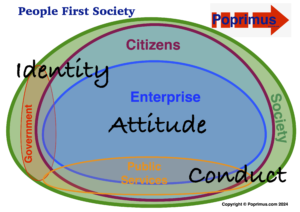
The ‘messy eggs’ sitting in the People First Society diagram might seem nonsensical and a major over simplification. It’s important, however to briefly explain and clarify the components before diving into the detail of the state we’re in (neck deep in smelly brown stuff) and what we can do about it. (Taking a very simplistic approach is deliberate and done in the hope that even clueless career politicians and civil serpents can undertand).
The diagram shows the fundamental core elements of a modern society and the broad relationships that exist between them. This particular diagram also shows an ideal(ised) picture of society in terms of the relative size and influence of each element. Critically it also highlights the essential core characteristics that are needed to form the foundations of society as well as the glue that binds the elements together. Identity, Attitude, Conduct: without collective agreement on these there simply won’t be any cohesive society to worry about. (Off the top of my head, and without any reference to search tools I would, for example, describe core characteristics of being British as being honest, law abiding, considerate, stoic, resolute, respectful and brave).
Identity refers to the characteristics by which an individual or group would wish to be known, both to and among themselves and by others (specifically not to physical characterisations such as by race, or by psychological / emotional positions such as sexuality and/or gender). Whilst not often explicitly stated, such a shared identity (especially for a society that is a nation state) is most commonly based upon values and principles laid down, and then cemented, over time.
Attitude refers here to a shared common mind-set that influences how we think, how we feel and how we approach dealing with, and solving, the challenges of everyday, and everyone’s, life.
Conduct refers to the common behaviours exhibited, both formally and informally, and adhered to in terms of interactions with others.
Identity is key. Identity addresses the most fundamental need humans have other than food and water: belonging. Belonging brings security. Four metre tall, armour-plated humans with four inch canine teeth and two inch claws do not exist. Safety in numbers is a basic instinct that extends well beyond our species. Modern so-called ‘progressives’ and liberals, that know so much better than nature does about how life works, fail completely to understand that identity is as important as an arm or a leg to to an awful lot of people (and therein lies the heart of the problem).
Now consider the major players within the society model. Why these players, their relative roles, responsibilities and authorities, as well as their relative size and scope in relation to others is fundamental to the operation of a functioning and upwardly aspirational society (and economy).
Citizens are the lifeblood of any society: without citizens there can be no society, nor would there be any point to a society. Societies exist (or rather, should surely exist, unless you subscribe to the worldview of the CCP) for the benefit of their citizens. This must be true for any free, functioning, forward facing society and is at the core of the full meaning of democracy. The word democracy comes from the Greek words “demos”, meaning people, and “kratos” meaning power; so democracy can be thought of as “power of the people”: a way of governing which depends on the will of the people.
Enterprise refers within this model to individuals, collections of individuals or groups that produce and provide goods and services for sale to others to generate wealth in order to sustain and, wherever possible, improve and grow quality of life. No modern, developed society can exist without enterprise. This fundamental principle is now universally accepted, even within former communist and socialist nations.: the only point ever up for debate is whether such enterprise should be driven privately or by government.
In essence government refers to the means of management of those core functions fundamental to the survival and healthy growth of a society that cannot safely or sensibly be left to either individuals, enterprise or other groups or organisations. Public Services are those core functions deemed essential by government for the greater good of society.
One key distinction needs to be understood in tems of the players and their relative positions within society. In almost all cases (the rare exceptions being the ones that prove the rule) citizens and enterprise are the wealth creators within society. They make profits or earn wages for their labour and pay taxes to government in return for essential public services (most critically defence of the state and maintenance of law and order).
Government and Public Services are the recipients of the wealth generated by citizens and enterprise (and even in the case where governments borrow, interest is owed and must be paid in either short term or long term depending on the nature of the instruments used). The fundamental point to understand in relation to government and public servies is that they consume wealth rather than generate it. The higher the level of government and public services expenditure the higher will be the level of taxation and borrowing. There are no exceptions. There is no magic money tree and there is no such thing as a free lunch. Sooner or later the bill must be paid and the bigger the bill the more money will be required from citizens and entrprise to pay it.
Reasons to be fearful
1. Identity theft.
There is no longer the widely held shared identity that once defined Britain, and being British.
For those born before the 1970’s, values and principles were rooted in large part by the shared experience of war. The hardships and horrors of WWII were experienced first hand, both at home and abroad, by the whole population, or relayed directly by parents to children born in the decades immediately following. The threat of war not only remained, but actually grew with the advent of the Cold War. With the real prospect of nuclear armageddon and a seemingly never ending arms race the fear was, perhaps for the first time, genuinely existential.
Above all else, however, and whatever the threats to be faced, a fundamental belief, and pride, in Britain as an essential force for good defined being British for an overwhelming majority (myself included). The very proper need for selflessness in the service of the greater good lay at the heart of the ideal and, regardless of other differences, united millions from widely differing backgrounds (primarily class) and political persuasions.
The fall of the Berlin Wall and the much-lauded end of the Cold War at the end of the 80’s however, removed the most basic of shared experiences, existential fear and a common foe.
The 90’s then saw the convergence of a number of disparate threads that appear to have led to a fundamental change in the mindset of a sizeable proportion of the privileged middle classes that dominate politics, big business, the higher levels of public services and, crucially, education and academia.
The ‘peace dividend’ from the “end” of the Cold War seemed to consign the threat of global conflict to history, and offer the opportunity of a shift to a more wholesome, humanitarian industrial and economic development path.
The growth of industrial and economic globalisation and the large scale de-regulation that accompanied (facilitated?) the tectonic shift between nations and continents seemed to offer nothing but opportunity for worldwide human development (and – crucially – for politicians and global corporations – cheaper cars, electronics and holidays in the sun to keep potentially tetchy voters onside).
The Maastricht Treaty (as if the wizards in Brussels simply rubbed a magic lamp and out popped a good and gentle Genie) proposed and implemented (without ever considering to seek the approval of the people they purported to serve – some would rightly call that facism) the first (albeit illusory) benevolent supra-state to replace the ‘anachronistic’, ‘dangerous’ and ‘divisive’ nation states across western Europe.
The increasingly influential mantras of universal human rights and anthropogenic global warming, both sponsored by that most responsible and reputable of global organisations, and high priest of the doctrine of noblesse oblige, the United Nations. It’s by no means a stretch to suggest that the explosion of the focus upon the downtrodden, the need t
o classify
2. Big Brother
No one ever recovered from any illness by ignoring the symptoms.


